_1776686475.webp)
Table of Content
▼- 1. Know Exactly What Bike Maintenance Costs in India in 2026
- 2. The Bike You Choose Determines the Bill You Pay
- Authorized vs. Doorstep Service Cost
- 3. Service Schedule The Habit That Decides Everything
- 5-Year Ownership Cost
- 4. Engine Oil Your Cheapest Protection Against Your Most Expensive Repair
- Engine Oil Cost by Bike Segment
- 5. Chain and Drivetrain The Silent Budget Killer
- Drivetrain Wear Intervals by Riding Condition
- 6. Tyre Pressure and Condition
- Recommended Tyre Pressure by Bike Segment
- 7. Riding Habits That Quietly Inflate Your Annual Bill
- Brand-Wise Annual Maintenance Cost Comparison
- Warning Signs Your Bike Is Costing You More Than It Should
- Bike Maintenance Priority Checklist
- Conclusion
Bike maintenance costs in India are silently draining the wallets of crores of two-wheeler owners in 2026, not because owning a bike is expensive, but because most riders make the same avoidable mistakes that include using the wrong service channel and missed intervals and neglected consumables and having no knowledge of what fair pricing looks like. The country operates its transportation system through motorcycles, whose number is more than 22 crore registered two-wheelers. Yet the average owner still overpays by 30–50% on routine servicing every single year.
This guide covers everything from service costs, the right bike choice, oil and chain habits, tyre management, riding style, and a full maintenance checklist. So the money leak stops now. Read this before your next service visit, not after.
1. Know Exactly What Bike Maintenance Costs in India in 2026
Before you can reduce costs, you need a baseline. The service pricing in India depends on three factors, which are your bike's brand and engine CC and the location you choose to visit.
- Authorized centers charge ₹800–₹2,500 for a general service depending on the brand and engine size.
- Doorstep and multi-brand garages charge ₹450–₹1,500 for the same job.
- A Hero Splendor Plus (100cc) general service starts at ₹600–₹1,000. A Royal Enfield Classic 350 service runs ₹1,500–₹2,500.
- Doorstep service costs 30 to 50 percent less because service providers do not need to pay for workshop space or electricity costs or showrooms expenses.
Bike owners who require three services each year will save between ₹1,500 and ₹4,500 through their channel selection process which will not affect their service quality for regular tasks.
2. The Bike You Choose Determines the Bill You Pay
This is the cost decision most riders make without knowing it is one. The Indian commuter segment has been engineered over four decades specifically for low total cost of ownership. Premium bikes look better on paper but cost significantly more over five years.
- Hero MotoCorp operates as the most economical motorcycle brand for maintenance in India because their spare parts distribution extends to all regions, including Tier-3 towns, and their service charges range from ₹800 to ₹1,200, which includes engine oil.
- The Japanese brands, which include Honda and Yamaha and Suzuki and the premium Indian brands, which include Royal Enfield and KTM, charge higher service fees because they enforce more expensive OEM parts and their oil specifications require stricter compliance.
- Scooter maintenance runs 10 to 20 percent cheaper than a motorcycle of similar CC in routine servicing because CVT belts outlast chain sprocket sets. The trade-off, when the CVT belt does fail, it is a ₹1,500 to ₹3,000 job which motorcycles never experience.
Authorized vs. Doorstep Service Cost
|
Service Type |
Authorized Centre |
Doorstep / Multi-Brand Garage |
|---|---|---|
|
General Service (100–150cc) |
₹1,000–₹2,000 |
₹600–₹1,200 |
|
General Service (200–350cc) |
₹1,500–₹2,500 |
₹900–₹1,500 |
|
Oil Change Only |
₹300–₹600 |
₹200–₹400 |
|
Major Service |
₹2,000–₹5,000 |
₹1,200–₹3,000 |
|
Chain & Sprocket Replacement |
₹1,500–₹3,500 |
₹900–₹2,500 |
The gap between the two numbers increases to more than ₹70,000 during the five-year period. The second budget bike costs the same as the item because it does not qualify as a premium product.
Also Read: Electric Bike Maintenance Tips for 2026 Complete Guide to a Smoother, Longer Ride
3. Service Schedule The Habit That Decides Everything
Skipping a service is the most expensive habit an Indian bike owner can develop. Small problems, a worn air filter, degraded oil, and a loose chain do not fix themselves. They compound.
- New bike: First service at 800–1,000 km. Non-negotiable. Missing this service voids early warranty claims at most dealerships.
- Standard commuter bikes require servicing after every 3000 kilometers or after two to three months of use whichever of these two events happens first.
- Premium bikes (Royal Enfield, Bajaj Dominar) require service at 5000 kilometers, which follows the initial two services that occur at 500 kilometers and 5000 kilometers.
- The mental counter needs to be reset after each service. Your next service becomes due at 15000 kilometers after your last service, which occurred at 12000 kilometers.
5-Year Ownership Cost
|
Expense |
Commuter Bike (100–150cc) |
Premium Motorcycle (200cc+) |
|---|---|---|
|
Scheduled Service (20 visits) |
₹20,000–₹26,000 |
₹45,000–₹70,000 |
|
Tyres (2 replacement cycles) |
₹6,000–₹9,000 |
₹12,000–₹22,000 |
|
Chain & Sprocket (2 sets) |
₹2,800–₹4,500 |
₹5,000–₹9,000 |
|
Battery (1 replacement) |
₹1,500–₹2,200 |
₹2,500–₹5,000 |
|
Brake Pads / Shoes |
₹1,000–₹1,800 |
₹2,500–₹5,000 |
|
Insurance (5 years) |
₹12,000–₹18,000 |
₹25,000–₹45,000 |
|
Total (excl. fuel) |
₹43,000–₹61,000 |
₹80,000–₹1,20,000 |
A Royal Enfield Classic 350 that follows the correct schedule keeps total 5-year maintenance between ₹15,000 and ₹30,000. The same bike, which receives its maintenance through irregular servicing, results in repair costs between ₹8,000 and ₹15,000 for each maintenance session.
4. Engine Oil Your Cheapest Protection Against Your Most Expensive Repair
Engine oil degradation is invisible until the damage becomes visible. The lowest cost for engine protection occurs through timely oil changes, which cost between ₹300 and ₹500 but protect against engine overhauls that range from ₹10,000 to ₹50,000.
- The owner manual provides specific fuel requirements, which need to be maintained through 10W-30 and 20W-40 and other approved grades. Using the wrong grade accelerates wear on cylinder walls and piston rings.
- The engine oil requires replacement after every 2000 to 3000 kilometers of use.
- Semi-synthetic oil requires replacement after every 5000 to 6000 kilometers of use.
- Top-ups should only use one brand and one grade of oil. The combination of different oil types leads to faster degradation and creates unwanted residue.
- Daily bike users should perform oil level checks on a weekly basis. The engine experiences measurable damage when it operates on low oil levels for distances of several hundred kilometers.
Engine Oil Cost by Bike Segment
|
Bike Segment |
Recommended Grade |
Oil Change Cost (Garage) |
Change Interval |
|---|---|---|---|
|
100–125cc Commuter |
20W-40 Mineral |
₹200–₹350 |
Every 2,000–2,500 km |
|
150cc Sports Commuter |
10W-30 Semi-Syn |
₹350–₹550 |
Every 3,000–4,000 km |
|
200–250cc Performance |
10W-40 Semi-Syn |
₹500–₹800 |
Every 4,000–5,000 km |
|
350cc+ Premium |
15W-50 Full Syn |
₹800–₹1,500 |
Every 5,000–6,000 km |
Also Read: 7 Types of Bike Tires Every Rider Needs to Know
5. Chain and Drivetrain The Silent Budget Killer
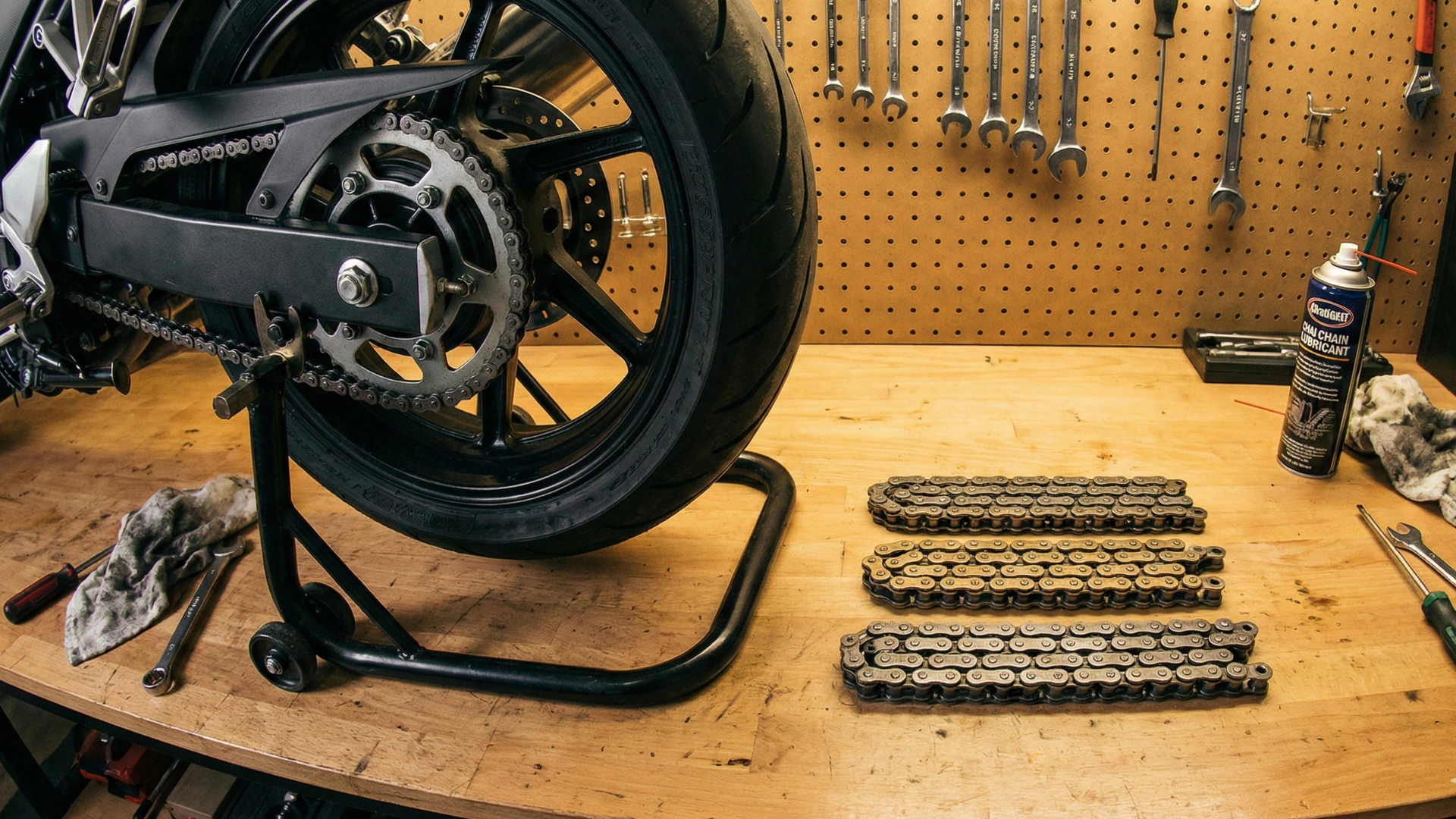
Indian bike riders who own bikes tend to forget about their chain and sprocket systems until the system experiences complete failure. A worn chain needs replacement because it destroys the sprockets together with itself which results in a ₹300 lubrication task becoming a ₹2,500 to ₹4,500 complete drivetrain replacement expense.
- The chain requires lubrication after every 500 to 700 kilometers of use. The chain requires dedicated chain lubricant, which should not be substituted with engine oil or WD-40.
- Use the correct lubricant for the season. Wet-formula lube in monsoon. Dry formula in dry conditions. Wrong lube attracts dirt and accelerates wear faster than no lube at all.
- Check chain slack every month. Refer to your owner's manual for the correct free-play specification, typically 20–30mm. A chain that is too tight or too loose damages both sprockets and the engine sprocket bearing.
- Replace the chain before it destroys the cassette. A chain that has stretched beyond its service limit begins filing teeth off the rear sprocket with every rotation.
Drivetrain Wear Intervals by Riding Condition
|
Component |
Normal Riding |
City Stop-Go / Highway |
|---|---|---|
|
Chain |
15,000–20,000 km |
8,000–12,000 km |
|
Rear Sprocket |
2 chain replacements |
1–2 chain replacements |
|
Front Sprocket |
3 chain replacements |
2 chain replacements |
|
Chain Lubrication |
Every 500–700 km |
Every 300–500 km |
6. Tyre Pressure and Condition
The only place your bike makes contact with the road happens through its tyres. The proper management of tyres requires no financial expenses. Ignoring them costs tyre life and fuel efficiency and safety.
- The proper time to check tyre pressure occurs during their cold state which needs to be done with weekly frequency. The post-ride pressure assessment shows a 3-5 PSI increase because of heat buildup which leads to false results that should not be used for making inflation decisions.
- When tyres do not have enough air pressure their rolling resistance increases. The vehicle requires more energy to operate which results in a fuel efficiency decline between 5 percent and 10 percent while tire lifespan decreases by up to 30 percent.
- Tyres need inspection after each ride to check for embedded objects which include glass and nails and stones that might be present in the tread. A nail discovered in a garage costs ₹150 to fix. The same nail discovered 20 km from the city costs ₹500 and your entire afternoon.
- The correct time to replace tyres occurs before the tread wear indicator shows complete wear while you should avoid replacing them after that point. The use of worn tyres during wet conditions on Indian roads leads to longer braking distances which result from monsoon weather conditions.
Recommended Tyre Pressure by Bike Segment
|
Bike Segment |
Front (PSI) |
Rear (PSI) |
Check Frequency |
|---|---|---|---|
|
100–125cc Commuter |
28–32 |
32–36 |
Weekly |
|
150–180cc Sports |
30–32 |
34–38 |
Weekly |
|
200–350cc Cruiser/Tourer |
32–36 |
36–42 |
Every 5 days |
7. Riding Habits That Quietly Inflate Your Annual Bill
Your riding style has equal importance to your maintenance of the equipment. The riders who practice aggressive riding will experience an annual maintenance cost increase of ₹5,000 to ₹15,000 because their riding style causes faster wear of equipment parts.
- The use of hard acceleration results in faster clutch plate and tire wear compared to smooth and gradual throttle control.
- The practice of late heavy braking decreases both brake pad and disc lifespan.
- Brake pads that should last 15,000 km wear out at 8,000 km under repeated emergency-style braking.
- The high-rev city riding pattern causes faster engine oil degradation, which results in shorter change intervals and increased cylinder wall wear.
- Pothole and road damage detection failure leads to wheel rim and suspension seal and steering bearing damage, which costs between ₹2,000 and ₹8,000 to repair.
- The practice of smooth riding enables riders to extend their vehicle components' lifespan by 30 to 40 percent, which results in annual savings between ₹3,000 and ₹8,000 without requiring any service center visits.
Brand-Wise Annual Maintenance Cost Comparison
|
Brand |
Approx. Annual Cost |
Parts Availability |
Service Network |
|---|---|---|---|
|
Hero |
₹6,500–₹8,500 |
Excellent |
Pan-India (Tier 1–3) |
|
Bajaj |
₹6,000–₹9,000 |
Excellent |
Pan-India |
|
Honda |
₹7,000–₹9,500 |
Excellent |
Pan-India |
|
TVS |
₹7,000–₹10,000 |
Very Good |
Pan-India |
|
Yamaha |
₹8,000–₹12,000 |
Good |
Urban-heavy |
|
Royal Enfield |
₹10,000–₹18,000 |
Good |
Expanding nationally |
|
KTM |
₹15,000–₹25,000 |
Moderate |
Urban centres only |
Warning Signs Your Bike Is Costing You More Than It Should
Do not ignore these. Catching them early turns a ₹500 fix into a ₹500 fix. The detection of problems leads to an inexpensive solution of ₹500. The detection of problems leads to an expensive solution of ₹15,000.
- Chain skipping under load or during acceleration, the chain is stretched, sprockets are already being damaged
- Brake lever travel has noticeably increased, or pads produce a metallic scraping sound
- Engine takes longer to warm up or idling feels rough after servicing, incorrect oil grade or missed air filter replacement
- Unusual vibration through the handlebar at speeds above 40 km/h, wheel balance or rim damage
- Fuel efficiency has dropped more than 10–15% from your normal baseline without explanation
- The Oil level dropping between service intervals, piston ring wear or gasket failure developing
Bike Maintenance Priority Checklist
|
Check Item |
Frequency |
|---|---|
|
Tyre pressure (cold check) |
Before every long ride |
|
Brake lever response and feel |
Before every ride |
|
Chain lubrication |
Every 500–700 km |
|
Engine oil level |
Weekly |
|
Air filter condition |
Every 2,000–3,000 km |
|
Chain slack and wear |
Monthly |
|
Brake pad thickness |
Monthly |
|
Battery terminal condition |
Monthly |
|
Spoke tension and wheel trueness |
Monthly |
|
Full engine oil change |
Every 2,000–6,000 km (grade dependent) |
|
Chain and sprocket replacement |
As per wear, not calendar |
|
Professional full service |
Every 3,000 km or 3 months |
Conclusion
Managing bike maintenance costs in India in 2026 is not about spending less, it is about spending right. The biggest savings come from servicing on time at the right place, keeping consumables from running to failure, and riding in a way that does not accelerate wear. For most Indian commuters on a 100–150cc motorcycle, annual upkeep stays between ₹6,500 and ₹11,500, and with consistent oil changes, chain care, and tyre checks, staying at the lower end is entirely within reach. The bike maintenance cost you prevent today is the repair bill you never pay tomorrow.
Frequently Asked Questions
Tanya Bhargava
Bike Blogger & Moto Content Creator. Tanya Bhargava is a passionate two-wheeler expert with 6+ years of experience in reviewing scooters, commuter bikes, and performance motorcycles. Her content blends real-world ride reviews, buyer guides, and industry updates tailored for Indian riders.