Table of Content
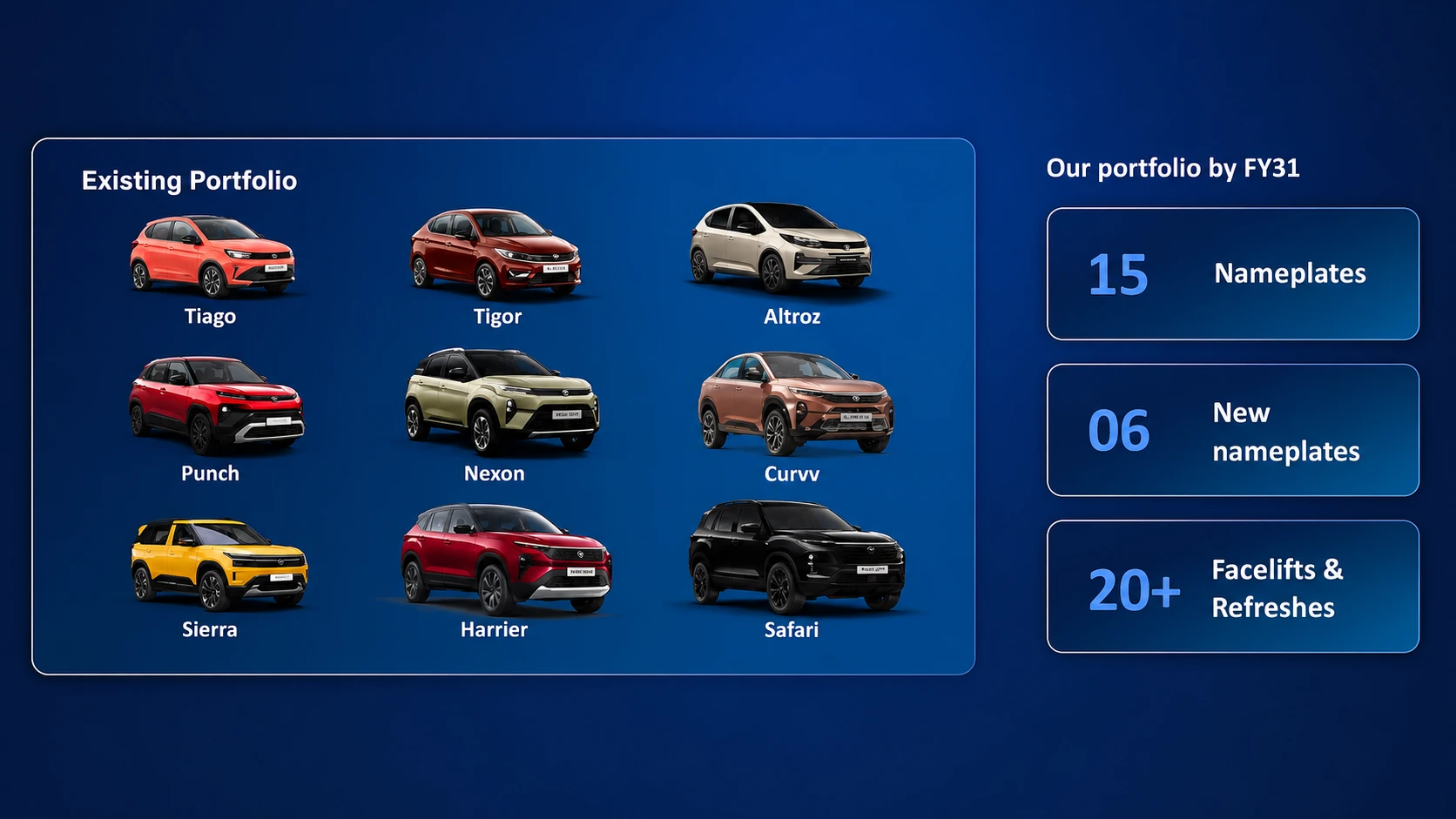
▼Tata Motors has revealed a product expansion strategy to grow its passenger vehicle portfolio to 15 models by FY2031, incorporating six all-new nameplates. This bold roadmap targets new market segments, aims for a major 18 to 20 percent market share, and outlines a plan to double annual sales volumes to over 1.2 million units by the end of the decade through multi-fuel solutions.
Strategic Product Blitz and New Nameplates
Announced during its high-profile Investor Day presentation, Tata Motors has mapped out a transformative roadmap for the Indian market. The manufacturer intends to execute more than 20 product interventions over the next five years. These interventions include completely new models, facelifts, feature upgrades, and powertrain enhancements.
The addition of six brand-new nameplates will play a critical role in helping the automaker enter unexplored segments. This expanded portfolio will offer a diverse mix of body styles and fuel options to cater to changing consumer preferences.
Near-Term Timeline for Upcoming EV Flagships
Tata Motors continues to prioritize electrification as a dominant pillar of its market strategy. The upcoming product launch pipeline showcases highly anticipated models engineered for premium performance:
- Tata Sierra EV: Scheduled for its official public debut on June 30.
- Tata Safari EV: Expected to arrive in premium showrooms around the festive season later this year.
- Tata Avinya EV Range: Under development, this premium flagship generation is likely to be introduced within the next year.
These rollouts underscore the brand's commitment to its electric lineup, which serves as a major growth driver.
Aggressive Electric Vehicle Roadmap and Volume Targets
Looking ahead toward the end of the decade, the manufacturer has set ambitious electrification metrics. Tata Motors is targeting a massive 30 percent electric vehicle mix within its passenger vehicle portfolio by FY2031.
This transition translates to annual electric sales of 3.5 lakh to 4 lakh units. The company will expand its EV portfolio from six models to 10. Executives project EVs will account for 15 to 20 percent of the total Indian industry by FY2031.
Capacity Scaling and Market Share Objectives
The ultimate benchmark is to cross annual passenger vehicle sales of over 1.2 million units by FY2031, a massive jump compared to the roughly 640,000 units recorded recently.
The following table summarizes the key metrics outlined in the corporate growth strategy:
|
Business Metric Category |
Current Baseline Levels |
Target Framework by FY2031 |
|
Total Model Portfolio |
9 Active Models |
15 Total Models |
|
Brand New Nameplates |
Base Baseline |
6 Brand New Additions |
|
Annual Sales Volume |
Approximately 640,000 Units |
Over 1.2 Million Units |
|
Domestic Market Share |
Current Market Standing |
18% - 20% Total Share |
|
Manufacturing Capacity |
Around 900,000 Units |
1.3 Million Units |
|
EV Portfolio Size |
6 Dedicated Models |
10 Dedicated Models |
Tata Motors is already executing plans to scale its manufacturing capability from the current 900,000 units to a robust 1.3 million units over the next two to three years.
Conclusion
The comprehensive vision presented by Tata Motors highlights its determination to remain a dominant force. By balancing traditional combustion upgrades with a rapid shift to 10 dedicated electric models and adding six new nameplates, the company is perfectly positioned to capture up to 20 percent market share by FY2031.
Neha Mehlawat
Neha Mehlawat is an automotive journalist and industry analyst with 10+ years of experience covering cars, bikes, and mobility trends. She tracks the latest launches, technology upgrades, and policy changes in the auto sector, delivering sharp insights that help readers stay ahead in the fast-evolving world of automobiles.