Table of Content
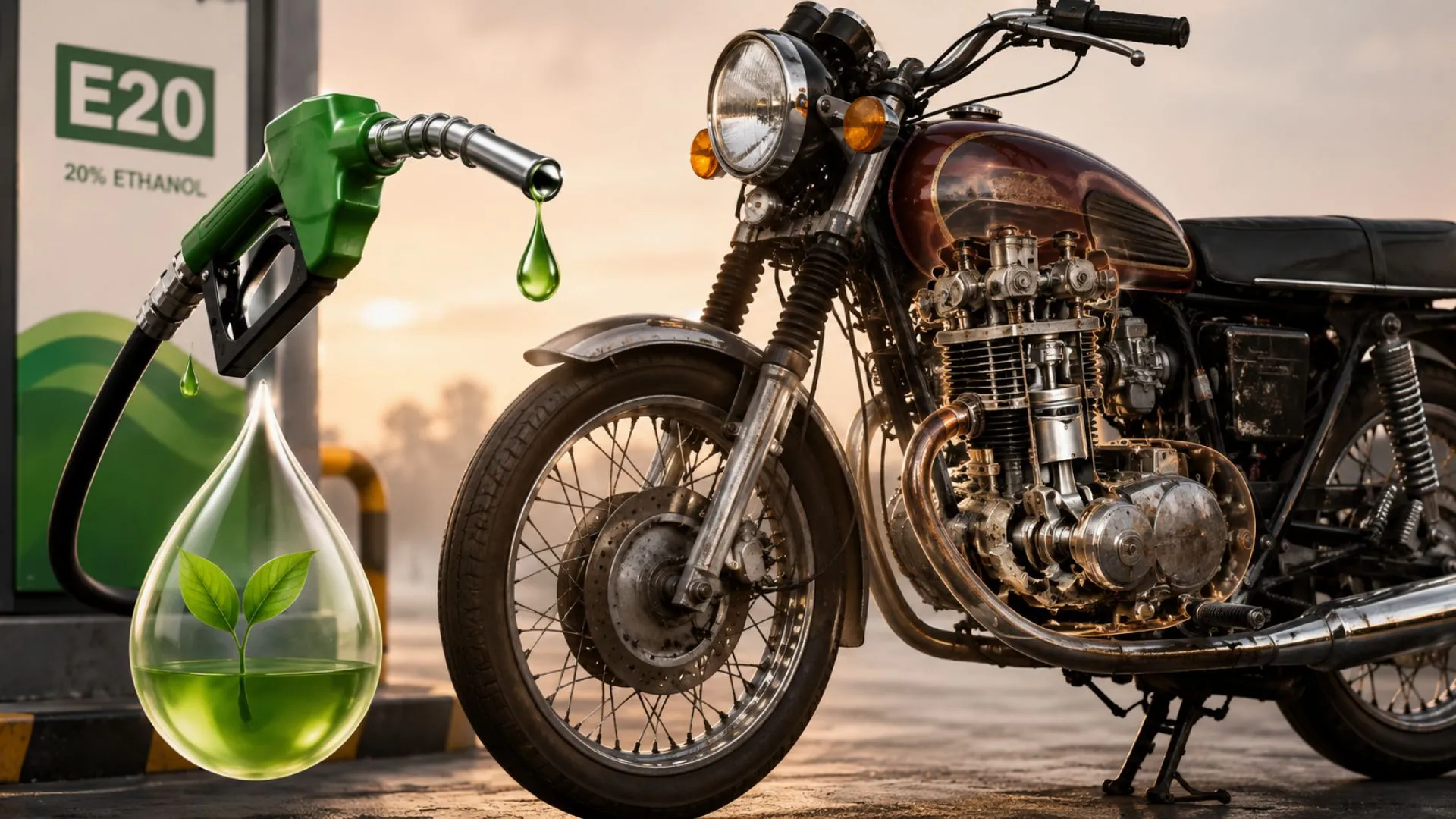
▼Every petrol pump in India now dispenses fuel blended with 20% ethanol, and for riders sitting on a five-year-old commuter or a decade-old carbureted bike, that switch wasn't optional. E20 fuel affects older bike engines in ways that rarely show up on day one, the damage builds quietly across thousands of kilometres, in the fuel lines, the rubber seals, and the oil that's supposed to be protecting everything underneath.
This guide breaks down exactly what's happening inside an older engine running on E20, which bikes face the highest risk, and the precautions that actually make a measurable difference over the long run.
In short: ethanol's higher moisture affinity and solvent action wear down rubber seals and fuel system components faster in pre-2020 bikes, cutting mileage by 3–20% and raising long-term corrosion risk, but consistent maintenance largely neutralises it.
What E20 Fuel Does to Older Bike Engines
Many people believe that E20 fuel is really just "green labelled" gasoline, but in fact ethanol has completely different chemical characteristics when compared to regular gas so these chemicals will create wear on the engine over time.
- Moisture absorption: Ethanol can absorb moisture from the air, diluting fuel and oil, and creating phase separation when left standing for extended periods.
- Material aggression: Fuel systems on bikes manufactured before BS4 used rubber and plastic components resistant to ethanol, leading to fuel system corrosion and seal degradation.
- Lower energy density: Ethanol provides less energy per litre versus pure gasoline, causing the loss of distance travelled reported by riders.
- Deposit formation: As a solvent, ethanol breaks down old varnish and gum deposits, which are then transported to injectors and carburetor jets, causing engine hesitation and rough running.
In one line: Older bikes don't fail on E20 overnight, they wear down gradually wherever rubber, moisture, and old deposits meet.
Bike Compatibility by BS Generation
Compatibility comes down to materials, not just age. Here's how the major manufacturers have positioned their own line-ups:
|
BS Generation |
Risk Level |
Manufacturer Position |
|---|---|---|
|
Pre-2017 (BS3) |
High |
Highest corrosion and seal-wear risk; not material-compliant |
|
BS4 (2017–2020) |
Moderate |
Honda and Bajaj claim material compliance back to BS4, with possible performance dip |
|
Early BS6 (2020–2023) |
Low–Moderate |
Royal Enfield's full range has been E20-compliant since BS6 launched in 2020 |
|
BS6 Phase 2 (2023 onward) |
Compliant |
Hero, TVS, and Honda confirm full E20 readiness from 2023 |
Also Read: Best Engine Oil for E20 Bikes in 2026: Problems & Protection Guide
Long-Term Problems Riders Report
These aren't hypothetical edge cases, they're the patterns showing up consistently across older bikes after extended E20 use:
- Reductions in Mileage: Mileage reductions of 3-20% have been observed based on how old/bike style you ride.
- Rubber and seal wear: Fuel lines are more prone to wear out than other components; with time, they will also require more maintenance because they are at a greater risk of leaking/corroding due to prolonged exposure to fuel.
- Tank corrosion: Moisture in ethanol fuel can cause internal rust in metal fuel tanks; often undetectable until engine performance drops significantly.
- Rough idling and hesitation: loosened deposits clog carburetor jets in older, non-fuel-injected models
- Cold start trouble: When deposits loosen from carburetor jets in older models without fuel injection, the carburetors will slowly clog and cause rough idling and hesitance.
Best Suited For / Not Ideal For
|
Best Suited For Continued E20 Use |
Not Ideal For Unmonitored E20 Use |
|---|---|
|
BS6 Phase 2 bikes (2023 onward) |
Pre-2017 BS3 carbureted bikes |
|
Bikes ridden regularly, no long idle periods |
Bikes parked for weeks at a time |
|
Owners following strict service intervals |
Owners stretching oil/fuel maintenance |
|
Fuel-injected models with sealed systems |
Older carbureted models with exposed rubber seals |
How to Protect Your Older Bike Engine from E20 Fuel
- Visually inspect all fuel lines, seals and O-rings every time you service your bike to find any leaks that may become apparent over time.
- Check your fuel tank for early rusting if your bike has a metal fuel tank.
- If you notice your mileage has decreased, or your bike has begun to idle poorly, have your carburetor re-tuned by a qualified professional.
- Ride periodically to keep fuel circulating and avoid phase separation
- Use only fully synthetic engine oil and reduce your oil-change intervals because the deposits left by burning ethanol will generally require more than just the additives in your oil to replace and clean.
Also Read: How to Reduce Bike Maintenance Cost in India in 2026
Bottom Line
|
Rider Profile |
Recommended Action |
|---|---|
|
BS6 Phase 2 owner, regular rider |
Continue normally, standard service schedule is enough |
|
BS4, early BS6 owner |
Add fuel cleaner additives, monitor mileage closely |
|
BS3/pre-2017 owner |
Inspect seals every service, consider a retrofit kit if available |
|
Any bike parked long-term |
Top up tank, add stabiliser before storage |
Conclusion
E20 fuel affects older bike engines progressively rather than dramatically, most of the damage being reported is accelerated wear, not sudden failure. Riders who stay ahead of it with regular fuel additives, attentive servicing, and the right engine oil will barely notice the transition. Riders who ignore it will eventually feel it, in mileage, in repair bills, and in engine life.
Regular fuel additives, correctly maintained engines and proper engine oils will help keep an engine from developing carbon build-up on the combustion chamber walls and piston dome surfaces, after which the transition to a rebuildable engine will be gradual for the rider who neglects maintenance. If they pay for these services, it will cost them more than if they did not perform them; this will lead to more carbon build-up, fuel consumption and engine lifespan.
Frequently Asked Questions

_1776686475.webp)