_1790319921.webp)
Table of Content
▼- What Is the e-Challan System in India?
- Who Uses the e-Challan System?
- How Does the e-Challan System Actually Work?
- Common Violations and e-Challan Fines
- Honest Note
- How to Pay an e-Challan: Online vs Offline
- Steps to pay online:
- How to Check e-Challan Status
- e-Challan vs Manual Challan: What Changed?
- Benefits of the e-Challan System
- What to Watch Out For
- Conclusion
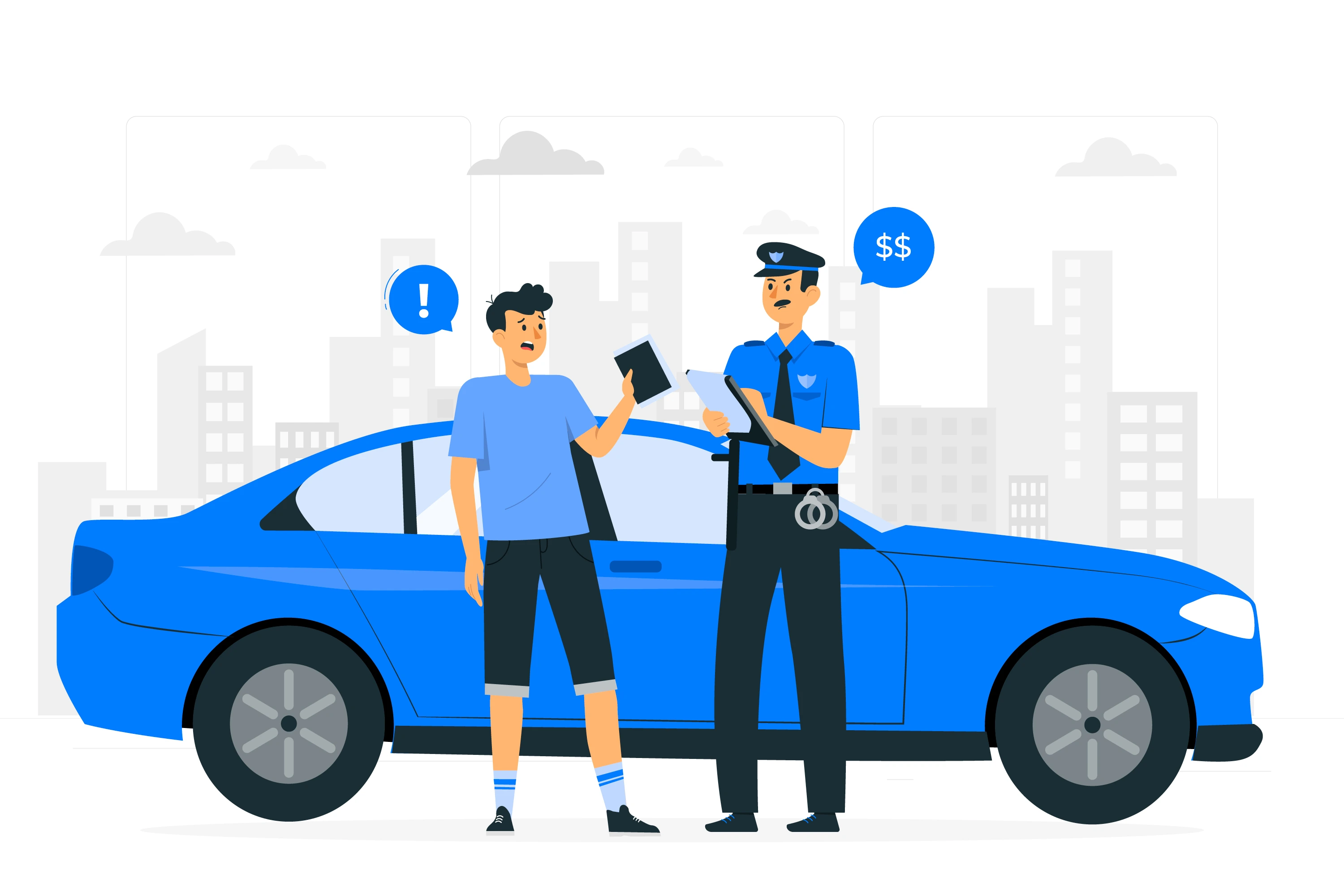
The e-Challan System India has changed how traffic rules are enforced on the country's roads. A cameras-and-database setup now does what a traffic officer with a challan book once did, and the notice reaches your phone within hours or days of the violation.
For many drivers, the first sign of it is an SMS about a signal they don't remember jumping. Understanding how the system detects, records and charges violations is now a basic part of owning a vehicle in India.
What Is the e-Challan System in India?
An e-Challan is a form of digital ticket which is issued by the traffic police to a vehicle owner for not following the traffic rules. The government introduced the e-challans in pilot projects in 2012 according to the Motor Vehicle Act, 1988.
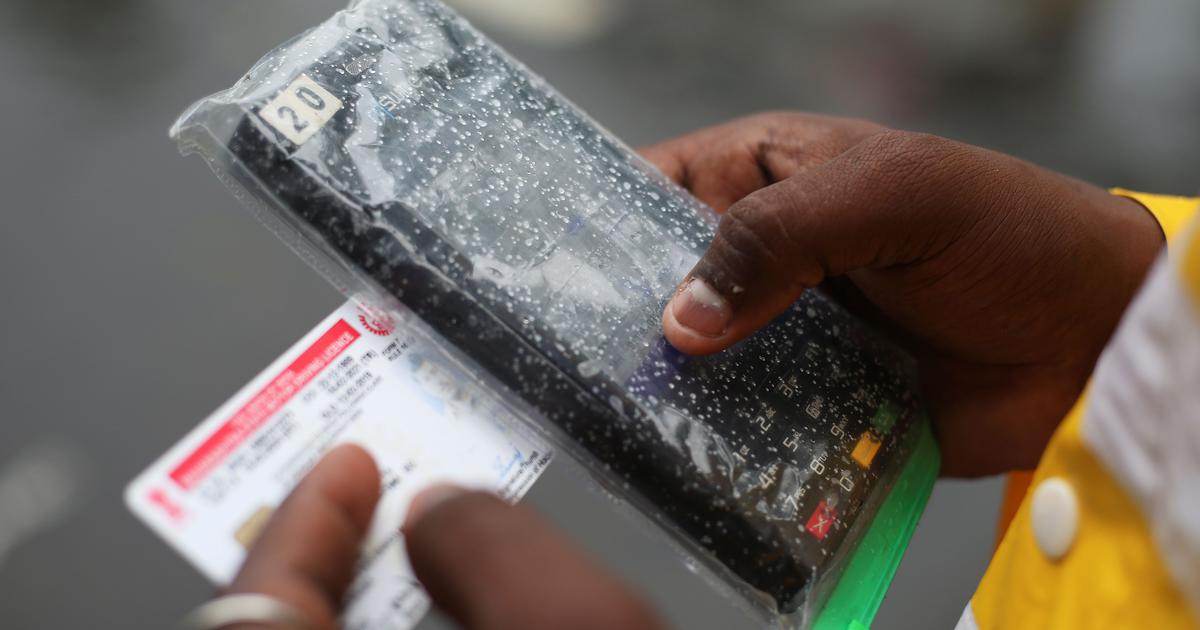
In practice, this means that the e-challan is a software application that has an Android application for the enforcement officer and a web-based interface for other people. The system is connected with Vahan (vehicles’ registration details) and Sarathi (driving license data), which means that the details of the owner get pulled automatically, rather than being written down manually.
Also Read: NHAI AI Upgrade: 1033 Highway Helpline Gets Smarter
Who Uses the e-Challan System?
The platform serves several stakeholders at once:
- Traffic police: Issue and track challans through the mobile app.
- Citizens: View, contest and pay challans online.
- RTO and STO: Maintain vehicle and licence records used to identify violators.
- NIC administrators: Manage the technical backbone of the platform.
- Ministry of Road Transport and Highways: Monitors data and enforcement trends nationally.
How Does the e-Challan System Actually Work?
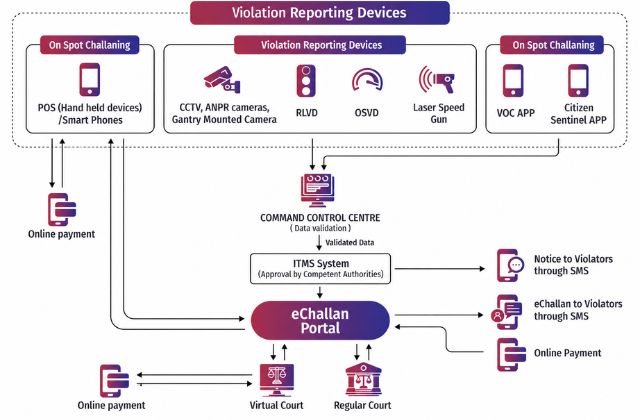
This process has a fairly easy order:
- Detection: On highways and in the city, such violations as speeding and running reds are recorded via CCTV, speed, and ANPR cameras. Officers may take photos of a crime and fix it in the app.
- Identification of the vehicle: The license number goes through the Vahan and Sarathi database to find the address and contact information of the vehicle owner.
- Fining: The amount of the fine for the crime committed is calculated automatically.
- Issuing of the notice: The RTO e-challan is delivered via SMS including the time and place of the offence.
- Payment window: The owner has a limited period to clear the fine.
- Evidence storage: Footage and photographs are stored for future reference in case of a dispute.
That's why enforcement no longer depends on an officer being present at the spot.
Common Violations and e-Challan Fines
|
Violation |
Typical Penalty |
MV Act Section |
|---|---|---|
|
Red-light jumping / dangerous driving |
₹1,000 to ₹5,000 |
184 |
|
Overspeeding (light motor vehicle) |
₹1,000 to ₹2,000 |
183 |
|
Riding without a helmet |
₹1,000 plus 3-month licence disqualification |
194D |
|
Not wearing a seatbelt |
₹1,000 |
194B |
|
Drunk driving |
₹10,000 and/or up to 6 months' jail (first offence) |
185 |
|
Driving without a valid licence |
₹5,000 |
181 |
|
Driving without insurance |
₹2,000 and/or up to 3 months' jail (first offence) |
196 |
Penalties can vary by state and vehicle category, so it is worth confirming the exact e-challan fine on the Parivahan portal or your state transport department's website.
Honest Note
This is the part drivers genuinely need to weigh: an e-challan is not always a matter of fair or unfair, it is a matter of records. If your mobile number linked to the vehicle is outdated, the SMS goes to the wrong person, and the fine keeps sitting in the system unnoticed. Waiting for a notification to tell you about a challan is where a lot of owners get caught off guard, often at the time of selling the vehicle or renewing a permit.
How to Pay an e-Challan: Online vs Offline
|
Factor |
Online Payment |
Offline Payment |
|---|---|---|
|
Where |
Parivahan e-Challan portal or SMS link |
RTO, traffic police office or designated court |
|
Details needed |
Challan, vehicle or licence number |
Challan notice and ID |
|
Payment modes |
UPI, cards, net banking |
Mainly cash, varies by office |
|
Availability |
24x7 |
Office hours only |
|
Receipt |
Instant digital copy |
Physical copy |
|
Effort |
A few minutes |
Depends on queues |
Steps to pay online:
- Click on the sms link or go to the Parivahan e-Challan portal.
- Fill in the challan number or vehicle number or driving license number.
- View the details of the violation as well as the supporting proof.
- Select the method of payment and make the payment.
- Get the receipt downloaded and saved.
How to Check e-Challan Status
Enter your vehicle registration number, challan number or driving licence number on the Parivahan e-Challan portal and select the option to view challan details. It takes less than a minute, and it is especially useful when buying a used vehicle, since you don't want to inherit the previous owner's unpaid penalties.
e-Challan vs Manual Challan: What Changed?
|
Factor |
Manual Challan |
e-Challan |
|---|---|---|
|
Detection |
Needs an officer on the spot |
Cameras and app, around the clock |
|
Transparency |
Scope for bribery and disputes |
Digital trail with photo evidence |
|
Owner details |
Written by hand, error-prone |
Auto-fetched from Vahan and Sarathi |
|
Fine amount |
Left to officer's discretion |
Calculated automatically |
|
Payment |
Cash at an office |
Online, anytime and anywhere |
|
Records |
Paper-based |
Centralised database |
The real value here isn't any single feature, it's that the process becomes consistent. The same violation is treated the same way regardless of who is on duty.
Also Read: Is the Volvo XC90 a Good Long-Term Family Car?
Benefits of the e-Challan System
- Better safety on the roads: Fair enforcement generates fear of violating regulations.
- Clear-cut and accurate data: Each offence, ticket, as well as payment are registered, which gives chance to conduct a research of the traffic situation.
- Lower levels of corruption: Digital technologies decrease the possibilities of corruption as well as money taking from officials.
- Convenience: Citizens utilise the online payments from any location without employing the help of a specific department.
- The process is paperless: All the notifications and receipts are sent electronically without sending notifications and receipts.
What to Watch Out For
- Outdated mobile number: Notices go to the number registered with the RTO, so update it after any change.
- Ignoring pending challans: Unpaid fines can be referred to a Virtual Court or regular court and may complicate ownership transfer or permit renewal.
- Assuming a challan can't be contested: If you believe a challan was issued in error, you can dispute it through the official portal or the court process.
- Missing the payment deadline: Delays can lead to additional penalties.
Conclusion
The e-Challan System India has made traffic enforcement faster and more consistent, replacing an officer's discretion with cameras, automatic fine calculation and instant SMS notices. Paying or checking a challan now takes minutes through the Parivahan portal, with the RTO or a traffic police office still available for those who prefer cash. Staying clear of it comes down to the basics: valid documents, a helmet or seatbelt, and insurance that covers you when the road doesn't go as planned.
Frequently Asked Questions
Karan Bhatia
Karan Bhatia is an automobile expert and reviewer with 8+ years of experience test-driving cars, bikes, and EVs. He provides honest, detailed, and practical reviews that highlight performance, design, safety, and value for money. His expert insights help readers make confident choices when buying their next vehicle.