Table of Content
▼- What Has Mexico Announced?
- Why This Matters For India
- Who Gets Hit The Most?
- Exposure of Major Indian Exporters
- Key Numbers At A Glance
- How The Tariff Hits India’s Auto Industry
- 1. Direct Impact On Pricing And Demand
- 2. Pressure On Production Planning In India
- 3. Risk To India’s Position As An Export Hub
- Industry And Government Response
- Lobbying By Automakers
- Diplomatic And Trade Policy Angle
- Broader Strategic And Supply-Chain Implications
- Alignment With US Trade Politics
- Supply-Chain Disruption Risks
- What Indian Auto Exporters May Need To Do Next
Mexico’s decision to raise tariffs of up to 50% on cars and other goods from India is a major setback for India’s auto industry, especially for exporters like Skoda-Volkswagen, Hyundai, Nissan and Maruti Suzuki that rely heavily on Mexico as a key overseas market. This single move alters pricing, margins, production planning and India’s positioning as a competitive export hub in a very big way.
What Has Mexico Announced?
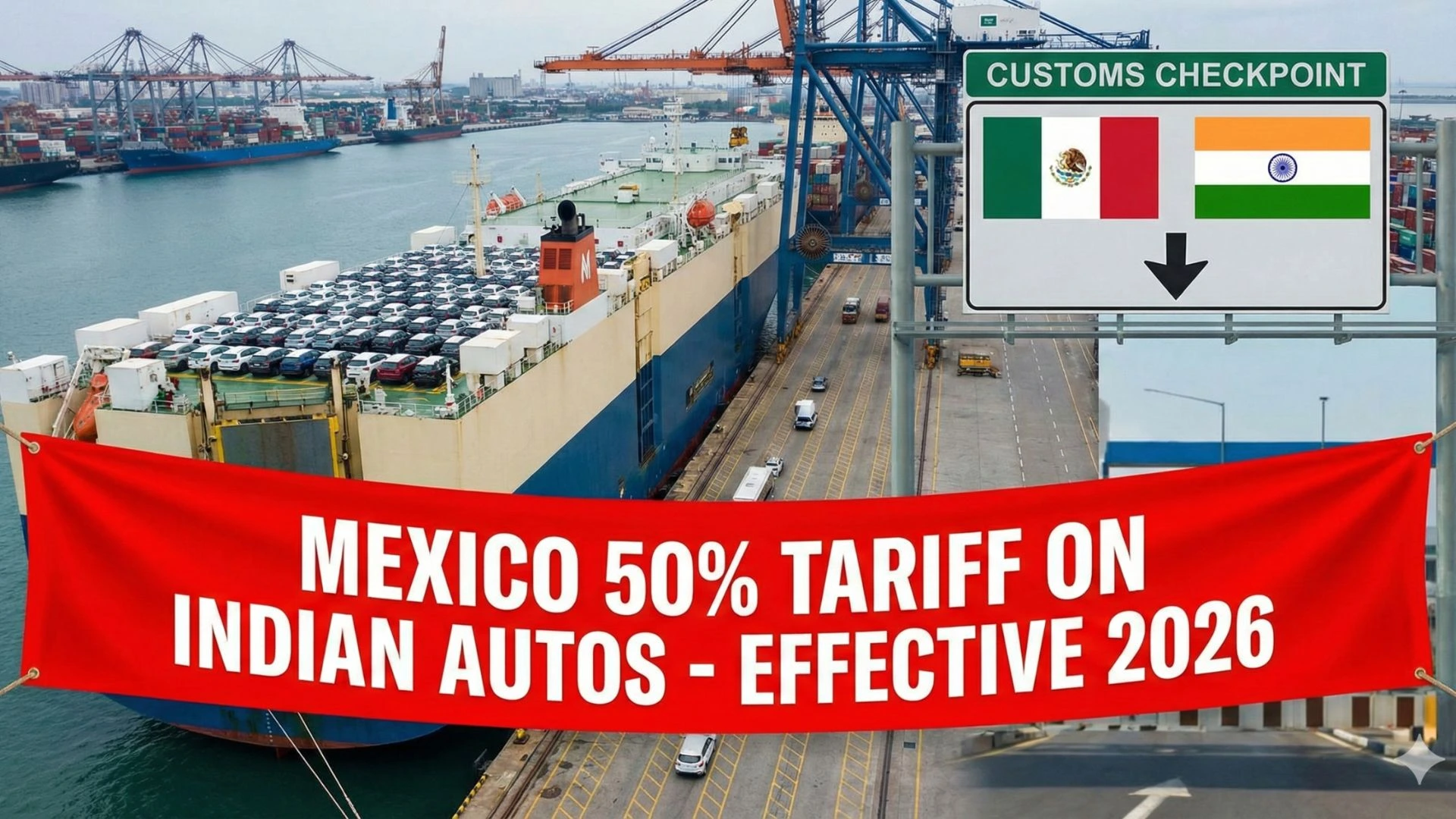
Mexico has approved a new tariff regime that raises import duties on more than 1,400 products from countries that do not have a trade agreement with Mexico, including India, China, South Korea, Thailand and Indonesia. For automobiles, the import duty on cars is set to jump from 20% to 50% starting 1 January 2026.
The tariff list covers:
- Autos and auto parts
- Textiles, clothing and footwear
- Steel, aluminium and other metals
- Plastics, household appliances, furniture and other manufactured goods
Mexico says the objective is to:
- Protect domestic industry and jobs
- Reduce dependence on Asian imports, especially from China
- Align more closely with the United States ahead of a review of the USMCA trade agreement
Why This Matters For India
Trade between India and Mexico has been growing, rising from about USD 7.9 billion in 2019–20 to over USD 8.4 billion in 2023–24. Within this, the automobile sector is a standout: India exported goods worth around USD 5.3 billion to Mexico in the last fiscal year, of which close to USD 1 billion was just cars.
Mexico is:
- India’s third-largest car export market after South Africa and Saudi Arabia
- A key outlet for compact and small-engine cars designed specifically for local Mexican demand
Because the new tariffs directly target autos and auto components, they effectively put this entire USD 1 billion car export corridor at risk.
Who Gets Hit The Most?
Exposure of Major Indian Exporters
According to customs data and industry letters:
- Skoda Auto/Volkswagen Group:
- Accounts for nearly 50% of India’s total car exports to Mexico.
- Hyundai Motor India:
- Exports around USD 200 million worth of vehicles to Mexico annually.
- Nissan:
- Ships roughly USD 140 million in cars from India to Mexico.
- Maruti Suzuki:
- Exports around USD 120 million worth of vehicles to the Mexican market.
Most of these exports are:
- Compact cars and small hatchbacks
- Often with engine sizes below 1 litre
- Tailor-made for the Mexican market and not meant for re-export to the US
The industry has argued that Indian-origin vehicles do not compete with Mexico’s higher-end production that targets the North American market, but they have still been swept into this higher-tariff framework.
Key Numbers At A Glance
Impact of Mexico’s 50% Tariff on India’s Auto Exports
|
Metric / Aspect |
Detail |
|
Start date of new tariffs |
1 January 2026 |
|
Duty on cars before change |
20% import duty |
|
Duty on cars after change |
50% import duty |
|
Total India–Mexico goods trade (2023–24) |
Over USD 8.4 billion |
|
India’s total exports to Mexico (last FY) |
About USD 5.3 billion |
|
Value of car exports to Mexico |
Close to USD 1 billion per year |
|
Share of Skoda Auto in car exports |
Nearly 50% of India’s car shipments to Mexico |
|
Hyundai exports to Mexico |
Around USD 200 million |
|
Nissan exports to Mexico |
Around USD 140 million |
|
Suzuki/Maruti exports to Mexico |
Around USD 120 million |
|
Share of imports in Mexico’s annual PV sales |
About two-thirds of 1.5 million passenger vehicles sold |
|
Share of India in Mexico’s PV market |
Around 6.7% of total PV sales |
How The Tariff Hits India’s Auto Industry
1. Direct Impact On Pricing And Demand
A jump from 20% to 50% import duty sharply increases the landed cost of India-made cars in Mexico, which can make them significantly less price-competitive versus:
- Vehicles imported from FTA partners like Japan or the EU
- Cars produced within North America under USMCA preferences
If brands pass the higher tariffs on to customers, retail prices in Mexico will rise, likely hurting demand for Indian models; if they absorb the costs, their margins will shrink. Either way, profitability and volumes are under pressure.
2. Pressure On Production Planning In India
Export orders to Mexico help Indian plants run at higher capacity, particularly for compact and small-engine models. With weaker demand expected:
- Plants may have to cut production or reallocate output to other markets
- Economies of scale achieved through strong Mexico volumes could erode
- Model-specific lines designed primarily for Mexico may become unviable unless redirected
This is particularly sensitive for companies that use exports to stabilise production when domestic demand is soft or cyclical.
3. Risk To India’s Position As An Export Hub
The tariff spike comes just months after the US also imposed 50% tariffs on many Indian goods, increasing the sense of policy risk for exporters. Analysts warn that:
- Higher trade barriers could undermine India’s pitch as a low-cost, reliable alternative to China for global manufacturing and exports
- Automotive OEMs may rethink long-term export-led strategies from India if key markets become protectionist
This adds complexity for the government’s broader “Make in India for the world” narrative.
Industry And Government Response
Lobbying By Automakers
The Society of Indian Automobile Manufacturers (SIAM), representing firms like Volkswagen, Hyundai and Suzuki, has:
- Written to India’s commerce ministry asking it to push Mexico to maintain the existing tariff structure on vehicles from India
- Argued that Indian cars form only a small slice of Mexico’s total market (around 6–7%) and do not threaten local manufacturers focused on higher-end segments
Automakers have also highlighted that their Mexico-specific exports are tailored products, and sudden tariff changes disrupt established supply chains and investment decisions.
Diplomatic And Trade Policy Angle
On the Mexican side, lawmakers faced strong lobbying from domestic business groups warning about inflation and supply-chain disruptions but still approved the measure to support local industry and manage US political pressure. For India, potential next steps could include:
- Raising the issue through bilateral diplomatic channels
- Exploring whether sector-specific carve-outs or phased implementation are possible
- Accelerating diversification of auto export destinations beyond Mexico and the US sphere
However, as of now, there is no clarity on whether Mexico will soften or delay the auto tariff hike.
Broader Strategic And Supply-Chain Implications
Alignment With US Trade Politics
Experts point out that Mexico’s move is closely linked to:
- The upcoming review of the USMCA free trade agreement
- US pressure, under President Donald Trump, to curb the inflow of Chinese and other Asian products into North America via Mexico
By imposing higher tariffs on Asian imports, Mexico signals alignment with US concerns but ends up catching India in the crossfire, even though Indian vehicles are primarily serving the local Mexican market rather than acting as a backdoor into the US.
Supply-Chain Disruption Risks
For multiple sectors, not just autos, these tariffs raise the risk of:
- Supply shortages or higher input costs for Mexican manufacturers that rely on competitively priced Asian components
- Inflationary pressure in Mexico, as analysts have cautioned, at a time when its economy is already losing momentum
For Indian automakers and component suppliers, the challenge is to:
- Reconfigure export routes
- Identify alternative markets
- Negotiate long-term contracts that factor in political and tariff risk.
What Indian Auto Exporters May Need To Do Next
To adapt to this shock, Indian OEMs and policymakers will likely consider:
- Market diversification
- Shifting incremental export focus to Latin America (outside Mexico), Africa, Middle East and emerging European niches.
- Product and pricing recalibration
- Reworking feature mixes or trims to retain some price competitiveness even with higher tariffs, or designing Mexico-specific packages if negotiations ease duties in future.
- Strategic engagement
- Coordinated industry–government efforts to argue that Indian exports support, rather than undermine, Mexico’s own industrial and employment priorities.
For now, the Mexico tariff story is not just a trade headline; it is a structural test of India’s auto-export model and its ambitions to be a true global manufacturing hub.
Neha Mehlawat
Neha Mehlawat is an automotive journalist and industry analyst with 10+ years of experience covering cars, bikes, and mobility trends. She tracks the latest launches, technology upgrades, and policy changes in the auto sector, delivering sharp insights that help readers stay ahead in the fast-evolving world of automobiles.